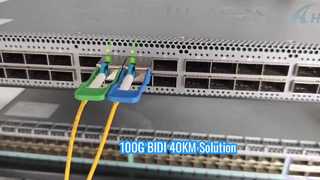
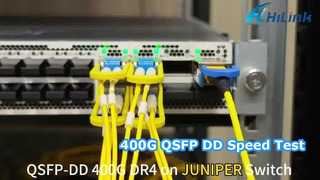
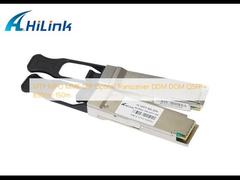
Brief: We show the practical steps and results so you can judge suitability quickly. This video demonstrates the OSFP-400G-DR4 optical transceiver, showcasing its operation in 400Gb/s network applications. You'll see how it transmits data over 500 meters using four 1310nm lanes and PAM4 modulation, providing insights for data center infrastructure planning.
Related Product Features:
Compliant with IEEE 802.3bs and 802.3ck standards for 400Gb/s optical and electrical interfaces.
Features a 1310nm EML laser for reliable signal transmission over single-mode fiber.
Supports transmission distances up to 500 meters using four lanes at 106.25Gbps each.
Utilizes 4-level PAM4 modulation format for efficient data aggregation at 425Gbps.
Equipped with MPO-12 receptacle for high-density connectivity in data center applications.
Operates with a single +3.3V power supply across commercial temperature ranges (0°C to +70°C).
Compliant with OSFP Module Specification and CMIS5.0 management interface standards.
RoHS compliant construction ensures environmental safety and regulatory compliance.
FAQs:
What is the maximum transmission distance of the 400G DR4 OSFP Module?
The OSFP-400G-DR4 transceiver supports a maximum transmission distance of 500 meters over single-mode fiber, making it suitable for data center interconnects and infrastructure applications.
What type of laser and modulation does this transceiver use?
This module utilizes a 1310nm EML laser and employs 4-level pulse amplitude modulation (PAM4) format, transmitting and receiving optical signals at an aggregated data rate of 425Gbps over four lanes.
Is this transceiver compliant with industry standards?
Yes, the OSFP-400G-DR4 is fully compliant with IEEE 802.3bs for optical interfaces, IEEE 802.3ck for electrical interfaces, OSFP Module Specification, CMIS5.0 management interface, and RoHS environmental standards.
What applications is this 400G transceiver designed for?
This transceiver is engineered for 400G BASE-DR4 Ethernet applications and is ideal for data center infrastructure, providing high-speed connectivity for modern network requirements.